For the terminally online, the multi-billion-dollar popularity of the Avatar series has been nothing if not perplexing. On release, each new entry saturates multiplexes around the world, collects billions in revenue ($2.9B for 2009’s Avatar, $2.3B for Avatar: The Way of Water), and disappears from online discussion forums and social media until the next entry overtakes multiplexes.
More likely, the disconnect lies in the presumption that the level or volume of online discussion related to a particular IP and its potential box-office revenue are inextricably linked. They’re not. The continuing success of the Avatar series strongly suggests otherwise. Whether the second sequel, Avatar: Fire and Ash, finds its way into the hearts and minds of moviegoers again could prove the theory.
Evaluated outside that unresolved question, it’s unfortunately clear that Avatar: Fire and Ash isn’t the triumphant conclusion to a three-story arc. Instead, it’s a frustrating example writ large of creative exhaustion. Said creative exhaustion belongs to James Cameron, the singular co-writer, world-builder, and director of the Avatar series.
Avatar: Fire and Ash opens approximately one year after the second film left the Na’vi, the native inhabitants of Pandora battered, bruised, but not beaten, and victorious over the forces of profit-driven, capitalistic greed, unsubtly represented by the Resources Development Administration (RDA), an Earth-based mega-corporation dedicated to extracting every exploitable resource from the planet.
Jake Scully (Sam Worthington), a former Colonial Marine turned Na’vi warrior, husband, and father, survived the second film’s events but lost his most favoured son, Neteyam (Jamie Flatters), to the so-called Sky People (humans and their machines). Left bereft by the loss and hardwired by years of military training and indoctrination into emotional avoidance, Scully repeatedly fails as a father to his remaining children, biological and adopted, or properly supporting his grieving partner, Neytiri (Zoe Saldaña), creating an intra-family rift that isn’t fully resolved until the film’s final moments (if at all).
Scully and Neytiri’s children include Lo’ak (Britain Dalton), the second and least favoured son; Kiri (Sigourney Weaver), their adopted daughter born with a special connection to Eywa, the planetary intelligence embodied in Pandora; Tuk (Trinity Jo-Li Bliss), the youngest and most vulnerable member of the family; and Spider (Jack Champion), a self-exiled human whose relies on a battery-powered breathing apparatus.
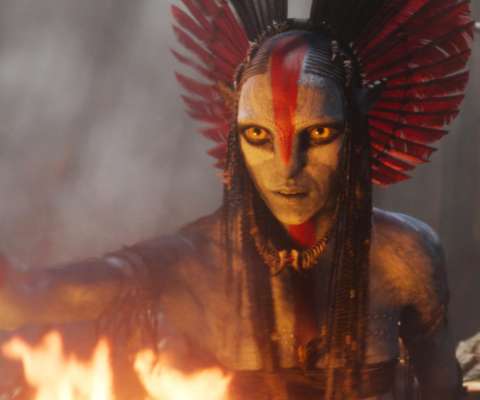
Spider’s breather becomes a nuisance and then a major plot point as the family decides to venture from the relatively safe environs of the Reef People to a human settlement where he can either locate spare batteries or, if needed, return to living with humans in their artificially oxygenated environs. To get there, of course, means travel, which almost always involves risk to Scully and his family, this time from the Mankwan raiders, an outsider clan led by Varang (Oona Chaplin), a sado-masochistic sociopath driven by an insatiable desire for power.
Said power arrives in the form of Colonel Miles Quaritch (Stephen Lang), Scully’s greatest foe, who, like Scully, left his human body behind for a Na’vi avatar. Unlike Scully, Quaritch didn’t have his consciousness permanently transferred into an avatar. He died, and the RDA, refusing to let one of their best investments perish permanently, transferred a backup take containing his memories into an avatar body. Even as a Na’vi/human hybrid (“Recombinant”), Quaritch hasn’t grown beyond his military training or his undying loyalty to the RDA and the military-industrial complex it represents.
After a sensory-shredding attack the flying ship that transports Scully and his family, the crew find itself separated (again), turning Avatar: Fire and Ash’s bloated, overlong middle section into an over-familiar series of partial and/or temporary reunions punctuated by chases on land, sea, or air.
After the Wind Trader attack separates Scully and his family, a peak set piece in both Avatar: Fire and Ash and Cameron’s decades-long oeuvre, the third film devolves into an over-familiar series of set pieces. More than one of them consciously references similar beats, shots, and scenes from its predecessors. Even the tantalizing addition of Varang and the Mankwan clan into the mix brings little beyond an unsubtle and clumsy attempt to create a parallel with the United States’ colonial history, specifically the temporary alliances between Indigenous communities and British settlers or American colonists against other First Nations.
Minus the areas where Cameron still excels (e.g., visually dazzling imagery, impressive world-building, spectacle-driven set pieces), Avatar: Fire and Ash flounders. It ultimately sinks on the predictable mix of well-worn genre tropes, repetitive and/or borrowed plot beats, and the cringe-inducing dialogue that have made revisiting earlier entries a serious chore for casual fans of the series. Or maybe a treat for the audiences who give it another few billion dollars.